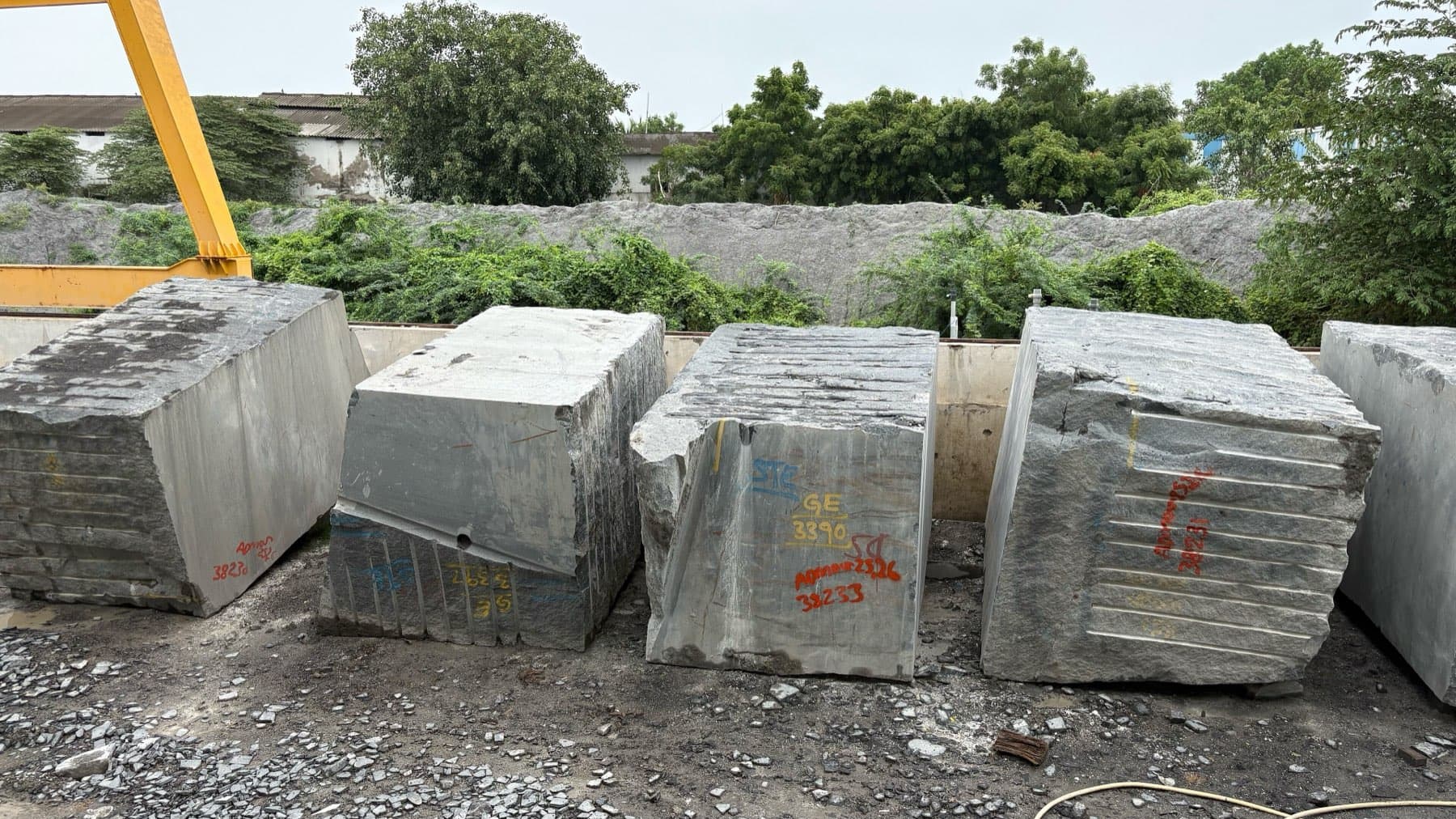
Recovery rate is the only variable in a dimension stone operation that multiplies rather than adds. Every margin downstream of the face, sawing, calibration, resin treatment, grading, packing, applies only to the volume that survived extraction. Improve any one of them and you improve one margin. Improve recovery and you improve all of them at once, because you have enlarged the base they are calculated on.
That is well understood in principle and badly served in practice, because the numbers usually quoted for what diamond wire recovers against blasting are not numbers anyone can source. It is worth setting out what can be defended, what cannot, and why the gap between the two is larger than the trade generally admits.
The most defensible figure available
A peer reviewed case study of marble quarrying in north west Iran, published by Abdollahisharif, Bakhtavar, Alipour and Mokhtarian in the Journal of the Geological Society of India in 2012, reports approximately a 26 per cent reduction in ore waste and a 21.3 per cent reduction in diamond wire consumption against the incumbent method at that site.
This is a single site, and a single site is not an industry. What makes it the figure to lead with is that it has a method attached, it was reviewed, and it can be read. Against the alternatives in this field, that is a considerable distinction.
It is also a substantial commercial result that sounds modest, which is precisely why it rarely gets quoted, and it came with lower wire consumption in a field where consumable cost and recovery are normally presented as a trade off.
The figure that cannot be traced
The claim in general circulation is that diamond wire delivers 60 to 90 per cent usable block recovery against 30 to 50 per cent under blasting. It appears in sector overviews, vendor material, development literature and consultancy decks.
We have not been able to trace it to any primary peer reviewed source, and the aggregators that repeat it cite no study. We are not asserting it is false. We are saying it is repeated without traceable sourcing, and that anyone building an investment case on a forty point recovery swing should know they are building on an unattributed number.
There is a further problem missed even by people careful about sourcing. The Iranian study and the circulating claim are not measuring the same thing. A 26 per cent reduction in ore waste and a doubling of usable block recovery have different denominators and cannot be reconciled by arithmetic. Presenting them together as though one supports the other, which is common, produces a business case no field measurement will ever confirm or refute.
The domestic baseline, attributed properly
The Pakistan Stone Development Company puts wastage under conventional blasting at around 85 per cent, falling to roughly 45 per cent where quarrying has been mechanised. These are PASDEC's own figures and should be read as the reporting of an interested body rather than as an independent audit.
Taken at face value they still say something uncomfortable. Even the post mechanisation number, 45 per cent loss, is poor by the standards of established dimension stone districts. Mechanisation is not the finish line. It is the point at which the remaining losses become visible enough to work on.
Where the loss is actually incurred, and where it gets booked
Waste in dimension stone arises from three distinct sources: irregular faces removed at secondary squaring, micro fracture, and natural jointing in the deposit.
Only one of those is caused by the extraction method. Jointing is geology and no method improves it. Secondary squaring loss is a function of block geometry, which method influences but does not determine. Micro fracture from blasting is the loss extraction method actually controls, and it is the one that behaves worst on a balance sheet.
Micro fracture is invisible at the face. A blasted block can look sound, square correctly and ship correctly, then come apart on the gangsaw or show as unsellable defect at polish. The loss is real at the moment of the blast and is discovered months later at a different site, frequently owned by a different company.
The consequence is a measurement failure that distorts capital allocation. The loss gets booked against processing yield, because that is where it appeared, rather than against extraction, where it was caused. Quarry economics look better than they are and plant economics look worse. An owner reading their own accounts honestly will conclude the problem is in the shed, and will spend on saws and polish lines while continuing to feed them material that was destroyed before it left the hill.
A fractured block cannot be un-fractured. The more useful version of that statement is that it cannot be identified either, not by the person who caused it, which is why the incentive to stop causing it is so much weaker than the economics warrant.
Why the bounded figure is the believable one
If jointing is geology and squaring loss is geometry, then a change of extraction method acts on a single component of total waste. That is the strongest argument we know of for treating the 26 per cent figure as plausible and the doubling claims as improbable. Removing one of three loss sources should produce a material but bounded improvement, which is exactly what the reviewed study found.
It also indicates where the rest of the recovery sits. Bench geometry does the work method cannot, and the working dimensions quoted for it in trade material are not figures we can attribute, so we leave them out. Best commercial raw block size is 6 to 8 cubic metres. Get the bench and the block plan wrong and a wire saw will cut beautifully shaped waste.
The wire itself, with the caveats it deserves
The operating parameters commonly quoted for diamond wire are, as far as we can establish, vendor sourced. We publish them as ranges to test against a supplier, not as specifications to rely on: 30 to 40 sintered beads per metre of wire; wire speed of roughly 30 to 35 metres per second in marble and 25 to 28 in granite; quarry cutting rates quoted up to 1.5 square metres per hour; acceptable wire yield of around 10 square metres of cut per metre of wire; wire life of around 350 metres in granite and 400 to 500 metres in softer stone in the 4 to 6 range on the Mohs scale.
Read as a set they are internally consistent and unremarkable, which is mild evidence for them. Read individually, each is a manufacturer's figure obtained under conditions nobody has described to you.
On cost we have to stop. We found no credible figure for cost per square metre of quarry cut and we will not publish one. There is a specific way this number gets fabricated and it is worth naming: multi wire processing consumable costs are reasonably well documented, and are sometimes presented as though they were quarry cutting costs. That is a different operation, on different stone geometry, with different wire. Any quoted cost per square metre should be checked first for which of the two it describes.
What follows from taking this seriously
The commercial case for changing extraction method does not require the unsourced numbers and is weakened by using them, because a buyer who checks will discount everything that followed the headline claim.
The case that holds is narrower and harder to argue against. Recovery multiplies through every downstream margin. Micro fracture is the one loss source extraction method controls, and it is systematically misattributed to processing, which means most operations do not know what it is costing them.
Which points at the first expenditure, and it is not equipment. It is measurement. Until an operation can trace a defective slab back to the block, the bench and the shot that produced it, it cannot price the improvement it is being sold, and it will keep buying the wrong thing at the wrong end of the chain with perfectly sound reasoning applied to the wrong numbers.